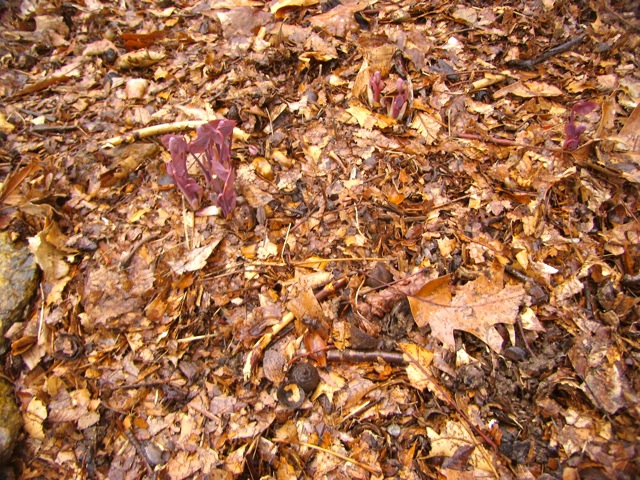
Photo by Corey Husic


Sunday, April 17, 2011

Phenology Note: April 17, 2011

Several spring ephemerals have started blooming like these dutchman's breeches (Dicentra cucullaria).


The flowers of dutchman's breeches are some of the first native wildflowers of spring.

Not long after the dutchman's breeches start blooming, the flowers and leaves of bloodroot (Sanguinaria canadensis) appear in damp woodlands areas.

This weekend, the earliest "fiddleheads" of the ubiquitous hay-scented fern (Dennstaedtia punctilobula) poked out of the leaf litter.
 
Off the forest floor, the leaves of serviceberry (Amelanchier sp.) are bursting from the buds.

In the wettest areas of the woods, the bright green skunk cabbage (Symplocarpus foetidus) are beginning to emerge from the damp soil.

Growing alongside the skunk cabbage, these turtlehead (Chelone glabra) shoots are pushing through the wet ground.

Another common plant species of wet areas is spicebush (Lindera benzoin).  The small, yellow flowers dot the branches of this small, woodland shrub.  In southern Monroe County, these began blooming this weekend.

 A close-up of a spicebush flower.

Although lots of flowers and plants are showing big changes this time of year, it is also important to take note of the animals inhabiting these same areas.  This Mourning Cloak butterfly stopped for a rest in the sun before continuing along the wooded path.

At the end of the recent warm days, the woods have been filled with insects, which are food for hungry predators like this bat that was found flying along the edge of a forest.

Thursday, April 14, 2011

Butterflies

Today, the weather warmed to the mid 60s at Lehigh Gap and the butterflies responded to the sunny weather.

The first three species were seen on the wooded south slope along the Woodpecker and Appalachian Trails at near the Osprey House at Lehigh Gap in northern Lehigh County, PA. This female Lucia Azure was brilliant blue as it flitted among the dead leaves and was difficult to see when it landed with its wings folded. This is a "new" species, as formerly this would have been called a Spring Azure.


A little farther along the trail, a bright, winter form Eastern Comma appeared.


 This was followed closely by a Mourning Cloak and a dozen or more of these bees. Spring was definitely in the air today.


Last Sunday (April 10), Dave Levandusky took this photo of a Palm Warbler at the Kittatinny Ponds at Lehigh Gap Nature Center. This is usually the first warbler species to be seen this far north in spring.

Sunday, April 10, 2011

An Annual Favorite

Each spring, Trailing-arbutus blooms along the road to my house. Oddly enough, it seems to grow best along the old road cut we made 32 years ago when we built our house. We have a one-third mile road that we built to reach the house, and it is lined with such beauties as mountain laurel, sheep laurel, and blueberries under the power line. The trees are cut out every five to eight years, so the area is always open to sunlight, but somewhat shaded by the shrubs. On the shaded road cut slope facing north is where I find numerous beautiful lichens, mosses, running-pine, and Trailing-arbutus (Epigaea repens).


Trailing-arbutus is a creeping evergreen shrub with leathery leaves. It flowers in early spring, before leaf out on the trees. Its blossoms are ½” wide tubular flower with spreading petals. The flowers often occur in small clusters and are quite fragrant (although I can no longer seem to smell things like this very well).


Trailing-arbutus leaves and blossom


Nearby I found another favorite – Teaberry (Gaultheria procumbens), another creeping vine-like shrub. It also has evergreen leaves that are reddish this time of year, and some of the bright red berries are still hanging from the plants. I remember my grandfather showing me these and encouraging me to taste the waxy berries in fall when their teaberry taste was at its peak.


Teaberry


And right next to that, I found a patch of Hair-cap moss with the sporophyte stages that will form the capsules full of spores growing on top of the green moss plants.


Hair-cap moss


I then went to check on the spicebush in a nearby hollow and found that the buds are swelling and will open soon. With 80ยบ temperatures predicted for tomorrow, these will be bursting soon.


Spicebush

NexRad and bird migration

In the last post, I mentioned that migrating birds can often be picked up by radar meant for monitoring precipitation and other weather conditions.  Well, in the region of Pennsylvania and New Jersey tonight (April 10th), there isn't precipitation, but there certainly seems to be a lot of migrating birds!


You can see the large migration imagery in the center of Pennsylvania.  The radar images shows a coastal storm that is now over New England.

Phenology notes from April 8 - 10th

Ian (from the Delaware Canal State Park) sent in a picture of the status of serviceberry buds from the Giving Pond Recreation Area (Upper Black Eddy, PA):

Amelanchier sp. (Photo by Ian Kindle)
From the Center Valley area Carolyn (a Master Gardener) writes that, as of Friday, the twinleaf is up an inch or two:
I wasn’t familiar with this spring ephemeral but it is lovely and has an interesting story:  http://www.mounet.com/~jdye/twinleaf.html.  This is a plant that needs ants to open the flowers. 

Paps (from Tuscarora State Park) tells us that:
While clearing leaves off the trail (the Spirit of Tuscarora Trail at the park) the following was seen. Fiddle heads of Hay- Scented ferns, leaves of Canada Mayflower, one inch sprouts of Fly Poison, and many cotyledons of Jewel Weed. Usually see Osprey migrating through at this time of year and today I saw it. This one appeared to have a band on its’ leg. Encountered the seasons first Wood Toad and Garter Snake. I’ll be checking the vernal ponds to see if the Wood Frogs have laid their eggs on Sunday.”

In Kunkletown on Saturday (4/9) we had the first Wood Ducks, Brown Thrashers, Pine Warblers, and Chipping Sparrow, as well as the first Eastern Comma (butterfly) of the year.  We also had a visiting Eastern Meadowlark, although it wasn’t the first of the year.

Last weekend the coltsfoot on Chestnut Ridge were opening; on 4/9, there were a lot of plants in bloom.  These are much later than the first ones we saw on the south face of Kittatinny Ridge (Smith Gap) back in February (2/28).

Did you know that when migrations of birds are at their peak, the flocks can be picked up by radar?  At night, you can check out http://rap.ucar.edu/weather/radar/ (for our region the Fort Dix link works well).  Last night there was evidence of a lot of migrating birds heading into south Jersey.  As you can see from the Cape May Bird Observatory blog, they are starting to see the migrants: http://cmboviewfromthecape.blogspot.com/.

We have been monitoring the movement north of Ruby-throated Hummingbirds at the two sites below.  Based on the information provided, we set out a feeder today.


Saturday, April 9, 2011

On Spring Peepers (Pseudacris crucifer):

From Tuscarora Township, Bradford County:  Peeping started Monday night (4/4), the frogs were silent Tuesday, and then were loud again on Wednesday (4/6).

From Beaumont, Wyoming County: a few Spring Peepers called for the first time on Wednesday night (4/6/11).

These reports illustrate how "signs of spring" gradually move north.  I received a report of Spring Peepers at Middle Creek on March 13th, but don’t know if that was a seasonal “first” or not.  In our area, the reports were varied (March 12th-18th in areas around our property in Kunkletown, in the SE corner of Monroe County, just north of the Kittatinny Ridge).  The peeping at our pond started quite a bit later (April 3rd) than at these other areas very close to us.  Perhaps this represented a migration to our pond from surrounding areas for breeding.  But in the northern counties the first "peeping" was several weeks later most likely reflecting differences in temperatures between the areas.

I received an email today from someone who said that they had always been told that spring peepers have to "freeze up" or be silent three times before it gets warm.  Have others heard this piece of lore?  Is there any truth to it?  This is an important thing to pay attention to in the future.
  
The gardeners use phenological events in nature to guide planting.  Apparently, when you hear Spring Peepers, it is time to plant peas (http://www.ghorganics.com/Phenology.html).  Where I live, that would be about right.

Eric Rensel, the Natural Resource Specialist to Park Region 1 (office at Parker Dam State Park in western Pennsylvania) has shared some phenological records from northern Clearfield County for us to compare with eastern PA.

Here are his records for first hearing spring peepers going back to 1995.

First Dates for Spring Peeper Calls in Clearfield County (Eric Wensel)
Some fun facts about Spring Peepers (see sources below):
§       Northern Spring Peepers spend the winter burrowed into soil or under logs and leaves. 
§       As a biochemist, I loved learning that they survive the freezing temperatures of winter by producing a sugar alcohol (glycerol) that serves as an anti-freeze preventing the formation of ice crystals in their cells!  They thaw and come out of hibernation when warm temperatures return in the spring.  Isn’t that awesome?!
§       The peeping in spring is from the males trying to attract a mate.  Anyone who lives in a heavily peeper-populated area knows how loud the males can be especially on warm nights.
§       There are different calls when males fight; a lower-pitched trilling whistle is made if one male moves in too close to the territory of another.  I wonder if anyone has witnessed frogs fighting.
§       The females reportedly choose their mate by the quality of the call.  (I can’t hear differences between the calls except for volume and the frequency of repetition.) Some reports say that the frogs that call the loudest and fasted are more likely to find a mate.
§       The females lay between 750 and 1300 eggs in small clusters attached to submerged vegetation.  Thus, the frogs must live near pools of water.  Breeding occurs between March and June (April is the main month).
§       Afterwards, they disperse to woodlands and swampy areas and live relatively solitary lives.
§       Tadpoles hatch in 4 to 15 days; metamorphosis occurs between 45 and 90 days after hatching.
§       They can climb but prefer to be on the grown or burrowed in the dirt.  I am convinced that they sense vibrations on the ground.  Whenever we quietly try to sneak up on them by our pond at night, they stop peeping.  When we walk away, they start up again.
§       Little is known about their lifespan, but it is unlikely that most live longer than 3 years.
§       One report says that they travel an average of 6.1 to 39.6 meters in a day.  Are there mini radio-collars to track these frogs?!
§       The Spring Peepers eat small insects and other arthropods including springtails.  But a number of things also will eat the peepers (snakes, larger frogs, fish, birds, etc.).  They are somewhat camouflaged so that probably helps to protect them.

Some references:
 

Friday, April 8, 2011

More phenology notes from the first week of April

April 8th:  Started with hearing the first Eastern Towhee of the season in Kunkletown.  This week was the first time we heard the “Pheeee-bee” call of the Eastern Phoebe although we have seen them around. 

Eastern Phoebe (Photo by H. David Husic
The Tufted Titmouse song “peter peter peter” has become a common sound now.

Tufted Titmouse (Photo by H. David Husic)
In Bethlehem today, I saw hyacinths in full bloom today and tulip buds very close to opening.  Some gardeners told me that their spring ephemerals were now up and close to blooming.  With the pending warm up to the 70’s and 80’s, they worry that the bloom time will be short-lived.
The first report of groundhog sightings I received was from 3/13/11 in a field near Kresgeville (Monroe County).  I saw the first one as road kill between Klecknersville and Point Philip on 4/7/11.

On April 7th, I received the first report of a Great Egret in the area – in a puddle along the road near Gremar Road (Northampton County).

Great Egret (Photo by H. David Husic)
The red maples are now in full flower in Kunkletown.

Paps reporting in from Tuscarora State Park (April 3rd):
"During this weekends visit to Tuscarora, to clean up the trail, I saw my first Kingfisher of the year. The Spicebush buds are starting to swell...Colts foot are blooming at several places...Marsh Marigolds are starting to emerge...Small groups of Ruby Crowned Kinglets were seen."

Ian reporting in from the Delaware Canal State Park (April 6th):
"I have heard that people are catching adult male shad in the Delaware as of last week, but I haven't yet confirmed a start date for the run this year."
~~~~~~

With the pending warm up, things should being to change rapidly over the next week. Get outdoors and let us know what you observe!